Thursday, May 3, 2018

Tinkering Tuesday: Food Truck Frenzy

As the year has progressed, I have created Tinkering Tuesday, a spin off of Maker Monday, yet geared toward our four and five year old makers. I tailor our maker activities to make them accessible to younger learners while also allowing more time for exploration and creativity. Maker Monday is in 25 minute time slots whereas Tinkering Tuesday is 50 minutes. As entrepreneurship is becoming more commonplace in education at the elementary and middle school levels, students are discovering their inner entrepreneurial spirits. Nurturing this spirit opens the door for so many creative learning opportunities.

I love the Food Truck Mindset that John Spencer uses to discuss innovation in schools. I appreciate his description of how food truck owners have to learn to empathize with the communities in which they are serving to be most successful. This idea created a springboard for a recent Tinkering Tuesday. 

I am constantly looking for ways to tie in our faith-based values into the special programs that our media department offers. Empathy is a central component to being a mensch, or a righteous person. When we take the time to work toward understanding others, we are instilling menschkeleit values. This is similar to the food truck approach: seeking to understand a community grows our level of empathy. On Tinkering Tuesday, I used the Food Truck Mindset to make this connection with students launching their own food truck business.

Students had a buffet line of items to consider in developing their food truck business: menu items, a list of necessary supplies, coupons to create, flyers to advertise the food truck, a catchy food truck design, and then finally the ability to make the food truck itself as a paper toy.
Buffet of Items to Consider for Creation of Food Truck Business
Business Card Design
Menu Items
                                                                   
Food Truck Designs


There was so much for the students to take into consideration throughout this process. First, who is the intended audience and therefore, what type of food should be served? Where will the ingredients come from: local farmers (another way to support the community) or will ingredients be outsourced from larger suppliers? How will the business be advertised most effectively? How will it be set apart from pre-existing restaurants? What will make the menu unique and yet, appealing? What is the best way to formulate a list of the supplies that will be needed in the food truck (list making is an important curation skill)? What designs will catch the community's attention? Setting a goal and walking through the steps to achieve that goal proved to be a worthwhile accomplishment. 

Whether it is Maker Monday or Tinkering Tuesday, I have discovered that students love activities that allow them to take home their creations. Our youngest makers call these "take aways". Students value take aways so that they can show off their work. In this activity, students took home their food trucks as well as the accompanying materials. While not every project involves a physical take away, I love that the process, just as much as the product, generates a take away. 

Wednesday, May 2, 2018

Wordless Picture Books & Maker Challenges

One of the best things about this school year has been the experimental maker activities with third grade. I have been on this mission to make curricular connections with the third graders while integrating literacy and maker projects. Our latest adventure has involved wordless picture books. 

One of our third grade classes was able to be partnered with our 4 and 5 year old class creating student leadership opportunities while forging relationships. The process is just as important as the end product in this activity. I create prompts centered around the curricular goal. Once a student selects their wordless picture book and tells the own story in their mind to coincide with the illustrations, they are given an envelope that corresponds to their specific book. In each envelope is a prompt and a challenge. Each challenge consists of a specific supply list that they can work from to create. They can go "shopping" for the supplies that they wish to use from their list:
Shopping for Supplies from the Maker Challenge Supply List

After their supplies have been gathered, they get to create something driven by their prompt. For example, each of our grades has a charitable theme throughout the year. Our third grade theme is called Gemilut Hasidim in Hebrew, which means to give loving acts of kindness. As a result, one of the wordless picture books that the students could select from among a pile of many was Sidewalk Flowers by JonArno Lawson. In this story, a little girl picks a bunch of wildflowers and gives them away throughout the day pleasantly surprising the recipients by her kind gesture. For this particular story, the girls created a kindness collage out of recycled magazines. 


After all of the creations have been made, students present to the class about their prompt and what it inspired them to make. As part of their presentations, they consider reflection cards similar to these shared by Jackie Gerstein. This entire activity is done in a fifty minute class period. To see more of their glorious projects, checkout @21stStacy and #davis3 on Twitter. 

Tuesday, May 1, 2018

Coding with Legos

Since last year's SxSWEDU conference, I have been introducing our littlest learners to coding concepts. I love the creativity required, the enthusiasm these kids have for learning, and the logic involved in the thinking process. Much of my inspiration has come from sitting in on sessions with author and educator, Ann Gadzikowski. Her practices don't necessarily involve more screen time but rather approach coding as a literacy, as opposed to a technical skill. 

I consider our innovation and design studio to be an incubator for learning. My students have shared many new vocabulary words in this space, one of my favorites being tryfail (the act of trying and then failing). It is a safe place for me to experiment with new lesson ideas and tailor them accordingly. We are all considered pilots in this space as we are experimenting with how things work together to accomplish specific tasks. 
Innovation and Design Studio, The "Incubator"

One of my favorite lessons involves coding with Legos for our littlest learners. Students in our 4 and 5 year old class create mazes out of Legos. Using sticky notes, they write arrows for the directions in which their Lego character should travel from start to finish to solve the maze. 
Code the cat to get to the witch

Create an algorithm using arrows to solve the maze

Students worked in groups of six. Two people created a maze together and then four coders worked together to solve the maze. When the coders ran into a problem (or a wall), they had to work together to debug. In this exercise, our students practiced computational thinking and learned patience, persistence, and the value of collaboration. 

Self-discovery is a significant part of the process. Some students were evidently hardwired to be leaders while others enjoyed taking direction from their peers. Carving out enough time for each student to build and code allowed students to reflect on which "job" they enjoyed most. 

Monday, April 9, 2018

March Madness: Competition in Education

Image result for competition quotes

Competition in education can be healthy but I prefer it to be optional. Some learners are self-motivated and they are best in competition with themselves. Competition can also lead to a one size fits all approach to learning, which counteracts any efforts to differentiate. However, gamifying the learning process is all the rage as many students enjoy external motivations. As a teacher, it is so important to know your students, consider the goals, and plan accordingly when approaching competition in education. Some individuals thrive under pressure while others deflate. Competition can bring out the best and the worst in people. 

Establishing a goal-oriented classroom in which students create personal goals for themselves and compete to achieve for their own well-being is ideal. Interestingly, this topic resonates with summer reading. Do you establish summer reading competitions to increase the amount of summer reading that occurs over the summer? If so, what is the reward if you read more than your peers? It comes back to the question: why are you motivated to read? Is it for yourself? Is it for recognition? Is it to please your teacher or librarian? The decision to build competition into education has to start with the goals in mind while considering the best path to reach those goals. 


Wednesday, February 21, 2018

The Power of Belief


Well, this is timely. The February #blogamonth topic is about doubting yourself or not believing in yourself. I happen to be on the horizon of accomplishing something new and different from anything that I have done before. Why do we doubt ourselves and what can we do to believe in ourselves? 

Above, I write the word "accomplishing". At the end of the day, each and every one of us knows that we have the power to accomplish our goals. When I start doubting myself, I remind myself of the hours and hours that I have put into achieving something. This comforts me. 

In a previous #blogamonth post, one blogger wrote that social media can make us doubt ourselves. We see so many others posting their successes and their achievements. We start to measure ourselves and become convinced that we are not as worthy. This is when we have to remind ourselves that social media does not tell the whole story nor does it necessarily spell out someone's goals. Those that we compare ourselves to may actually have very different goals from our own. This matters and sometimes we forget that. Often times what we choose to share is driven by our goals.

It is human nature to doubt ourselves. I appreciate that we are reflecting on this topic during the winter Olympics. The stories of the athletes is enough to remind us that we can gain so much from not coming in first place. We can work hard to come out stronger and better. It is all about transformative growth. Worst case scenario: We fail. From failure comes learning. From learning comes success. 

I also believe in the power of process. Many of us find comfort in ritual or process. When staring something scary in the face, doing the work and going through an arduous process can give us layers of comfort, armor, and confidence. When feeling vulnerable on the edge of tackling something new, I think about things that I knew nothing about once upon a time and later became an expert on that very thing. We cannot underestimate the impact of positive self talk. It reminds us of our own power to control our outcomes. 


Wednesday, January 24, 2018

January's #BlogaMonth Topic: The Most Important Lesson

Our greatest glory is not in never falling, but in rising every time we fall.

In the spirit of the month of resolutions, I find myself being more introspective than usual. I think most of us pause to reflect and think about what we hope to achieve in the year ahead, even if we don't believe in the cliche of new year resolutions. Sometimes my goals extend beyond myself and involve how I might interact with the world in a way that is different or better. 

When I think about how I can impact my students and their growth, I think of one word: resilience. For me, it always comes back to this. If a person can learn strategies to be resilient, they can move forward from almost anything. I want my students to learn that there are so many situations that we cannot control but we can control how we react to them, what we learn from them, and how we grow forward from them. When I asked a class of fourth graders today if they knew that word, most did not. This is good. It gives me the opportunity to grab their attention and begin the first of what will be many life lessons on the meaning behind the word resilience. With a dose of resilience in their back pocket, they can confront anything.

On a separate and somewhat lighter note, I have been encouraged to share what I believe to be the worst commercial on T.V. I think it's pretty obvious: Publix commercials! They tug on the heartstrings a bit too much. Who has ever gotten through a Publix commercial without shedding a tear?


Tuesday, December 12, 2017

December: The Month of Giving and Receiving


A core part of my role as 21st Century Learning Coordinator is to share: Share new tools, share ideas, share connections to others doing great things, share learning spaces, share books, share technology, and of course, share time. We live in a culture of sharing. In the spirit of Oprah's favorite things, if I am to share my favorite things, it's quite a list. When it comes to learning and technology tools, I can narrow them down to just a few, although my big list is quite long. Since you are sharing your time with me, I'll share my my short list:

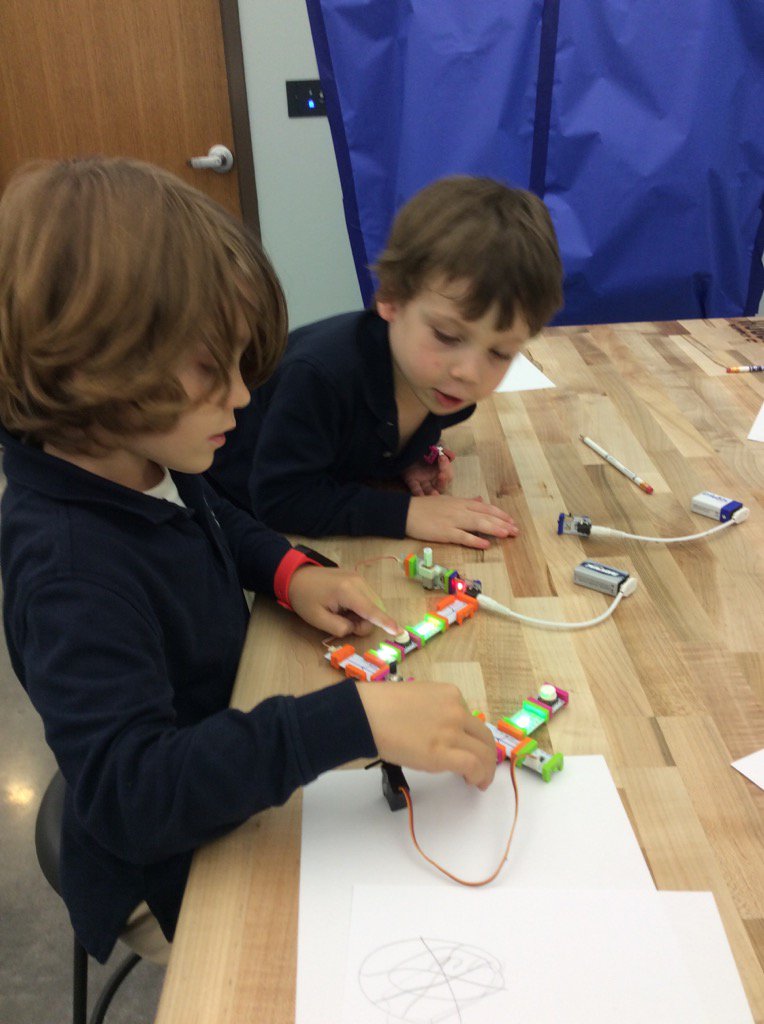
  • littleBits- I simply love them. They make engineering and technology accessible to all. Check out our own littleBits page: https://littlebits.cc/inventor-clubs/lion-littlebits
  • Hummingbird Robotics- Even with the invention of so many similar products, I still love the good ol' Hummingbird kit. It comes with a microcomputer, LED lights, sensors, motors, and servos to allow the perfect combination of building something unique from scratch and then incorporating the technological components. The learning curve is large and the process is rewarding with this tool.
  • The Library- Whether it's our school library or my public library, the library has it all. When I need to explore a new topic or dig deeper into something I seek to understand, it's the books and journals I value so much along with the unlimited access to online information. There's no place like the library.
  • Colleagues- Lately, I've been doing a lot of collaborative lesson planning and there is definitely something special in how the lesson evolves into something great when more minds are involved. We all bring our own creative experiences to the process. Our unique experiences and ideas makes a mixture full of magic, which adds more energy and passion to the process.
To share is to give but it is also to receive. We receive the satisfaction of knowing we took part in something bigger than ourselves. We receive the good feeling of being able to help others and find satisfaction in that feeling. Discovering new technology and/or learning tools and learning new ways to use the old keeps learning and teaching interesting. I look forward to more of the same in 2018.