Tuesday, March 10, 2015
Some Seriously Savvy Students
Every now and then I get carried away. I know that I do it and yet, I still do it. This most recent cause of my runaway enthusiasm was the Technology Fair. For the second year, we have had lower school students participate in what has historically been a "middle school event" for our school. This year was a bit different, however, in that we had a record-breaking number of lower school student participants. It goes to show that the power of marketing really is amazing. I started advertising this year's technology fair during the first week of school. I sent out constant reminders, emails, tweets, signage, you name it to advertise the January registration date for the Technology Fair. Basically, I became a nag. Amazingly, it worked. With the help of the Middle School Media Specialist (@Bookman30022) by registration date between our two campuses, we had approximately 62 registrations for various categories. At this point, our school was feeling proud.
Next came competition day. Again, strong feelings of school pride as we placed in so many different unique categories. You can't help but get the chills as the Director of the Technology Fair calls up the winning students to retrieve their award. Interestingly, I happened to be absent that day as I was at Educon in Philly but I followed along so enthusiastically via Twitter and it brought me back to the pride I felt the previous year. At one point I was sitting in a conference session and I yelled out loud as I was seeing the names come across my Twitter feed. (Another piece of evidence of my getting carried away.) All of those who won first place then made it to the state level. Here's what was interesting though: by the time the state round came to be, we all already felt like winners. Students devoted their own time to these projects and with a little encouragement, a lot of enthusiasm, and superior parent support, they accomplished these remarkable projects that we now all feel so passionate about.
In fact, it shouldn't end with the Technology Fair. Throughout the remainder of the year, I am seeking opportunities to showcase the participants' projects. Today, I showed one of my classes a stop motion animation video created by two 5th grade girls out of Legos. They told the class how they worked for two months, took 3000 photos, and borrowed equipment from various family members to create the amazing project that we were now watching on the big screen. The students were dazzled. I mean seriously impressed. At that moment, I think they realized that they too can create something remarkable.
It's hard to understand how something as routine as a Technology Fair can bring out the level of pride that it has but, it has. Personally, I am so proud of the bravery, the courage, the creativity, the investment, the devotion, and the support that the tech fair participants demonstrated. Each and every single one of them.
Thursday, February 5, 2015
Nuggets of Wisdom from EduCon
Each and every day I feel so grateful for my social media PLN. The best is when I come across information that directly relates to something I am trying to do myself. This usually saves me quite a bit of time. Even better is when you get to expand your PLN in person and be surrounded by educators that are trying to make a difference in ways that surprise you. Having recently returned from EduCon 2.7 I was invigorated by the nuggets of wisdom that I encountered. In the spirit of sharing and intrigued by Tony Vincent's recent Learning in Hand Show about InfoPics, see some of my EduCon gems here:

There were so many great things about this conversation. One idea that I took away is creating low tech moments in your classroom to demonstrate the importance of protecting yourself online. I did not realize how fun this could be! Some tactics included bribing your students to change their passwords. See a student's mobile device laying around? Do a security check. Does their device have a passcode on it? Go on a phishing hunt and identify spam together. Conversations about protecting yourself online should not always be based on fear.
Doodling the C's: Creativity, Collaboration, Comprehension, & Connections by @jgough & @lottascales
#Edsec: Information Security and Privacy in the Classroom by @jessysaurusrex
There were so many great things about this conversation. One idea that I took away is creating low tech moments in your classroom to demonstrate the importance of protecting yourself online. I did not realize how fun this could be! Some tactics included bribing your students to change their passwords. See a student's mobile device laying around? Do a security check. Does their device have a passcode on it? Go on a phishing hunt and identify spam together. Conversations about protecting yourself online should not always be based on fear.
Doodling the C's: Creativity, Collaboration, Comprehension, & Connections by @jgough & @lottascales
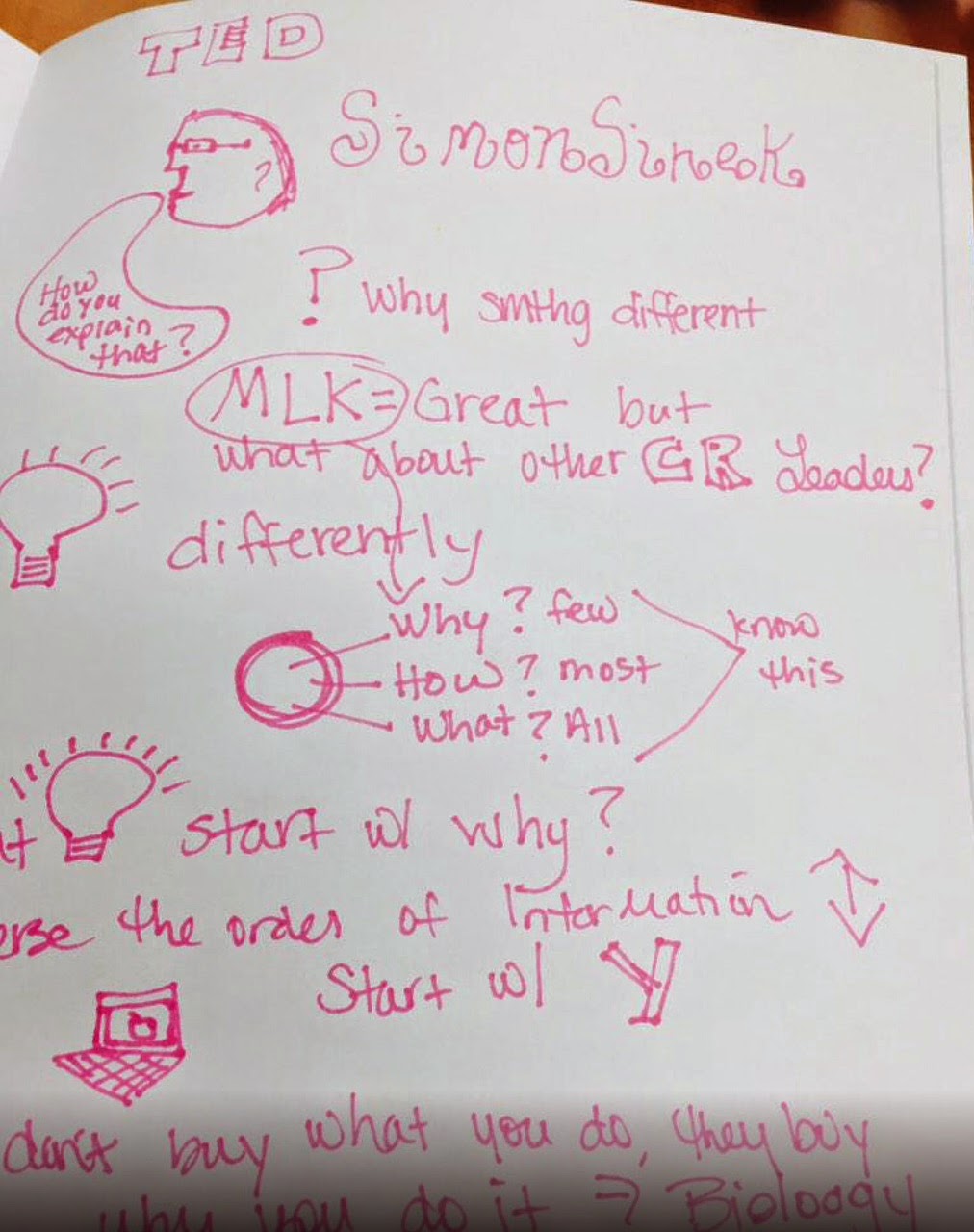
Another valuable conversation that I participated in involved the magic of doodling. Inspired by Sunni Brown's Visual Literacy for a Smarter World, this discussion focused on how doodling can actually assist us in retaining knowledge. When we take notes while listening to information, our brain is competing with itself. However, dual coding theory teaches us that our verbal and visual skills live on two different channels of our brain. When we practice doodling while listening to information, we can produce valuable notes that encourage creativity and comprehension. There are two rules to sharing your doodles: 1) admire the doodles of others and 2) look for things to steal. To test out this theory, we doodled our notes while listening to Simon Sinek's TED Talk, Start with Why. Above you will see the notes that I produced while listening. After doodling through the TED Talk, we admired each other's work and discovered great ideas to steal. The art of doodling is a skill and therefore, it is something to practice in order to improve. I love that I've added doodling to my "to do" list.
Rethinking the Purpose, Promise, and Process of Professional Learning by @kristenswanson and @djakes
Besides gaining the value of perspective from having several different parts of the world represented at my table, this conversation challenged me to rethink learning. The first thing I discovered was to ask who decides the learning and why. The who answer to this question can usually reveal so much about the influence behind our professional learning. In discussing the different teaching models between elementary, middle and high school, some participants mentioned that while elementary school felt student-centered, in middle and high school it becomes subject-centered. Why is this? I have my own ideas but most importantly, it is important food for thought.
Additionally, there was much discussion about how we can create the conditions in which learning can take place. A brilliant example that Kristen Swanson gave was in asking the attendees how many of us rediscovered a hobby over winter break. Almost every hand went up. I know my hand went up. Why do we rediscover hobbies over our holidays? Well, for one, we have the time and two, we have the freedom. In school, shouldn't we create these same conditions in which all learners can discover and explore their interests? This has become known as "white space". This idea has really made me think about the power of choice and the power of time and what both of these look like in my classes.
There were so many powerful learning opportunities at EduCon. I didn't even mention the conversation about social entrepreneurship or what it was like to learn about the big picture in education from the Chief Education Office of Philadelphia city schools or what it was like to chat with Meeno Rami, author of Thrive. It was simply great. If you have the ability to choose your professional learning next year, I highly recommend EduCon.
Monday, October 20, 2014
All Good Things Must Come to an End
Not to sound disappointed or anything but I have to admit that I was somewhat sad on our last day of our Technology Exploratory in which our 5th graders became entrepreneurs. I had never modeled a class in this way before so I really was learning along with the students. For lack of better words: it was so much fun! It truly was. What made it so much fun?
First, the students were into it. (If they weren't, they are really good actors and actresses.) I loved that they were so engaged. Second, we all had no idea what we were doing and it showed. This is what made it so exciting! The possibilities proved to be endless as students' creativity knew no boundaries. At the end of the quarter, we had an electronic fish feeder, an automatic dog leash, paper that prints out videos (yep, you read that correctly), and a remote control for the car (why hasn't this been invented yet?!). Third, the students were learning and didn't even realize that they were learning. Ultimately, they became proficient in writing a business plan, launching a social media campaign, advocating for their business on demand, developing a prototype, and creating a budget. Each of which can translate into fairly useful life skills. Oh yes, they learned a thing or two about tech tools along the way.
I will miss this uninhibited creatively fervent class. However, don't feel too sorry for me as I have a new group of rookies starting tomorrow. The only difference is that I might actually know a little bit about what I am doing this time around...for better or worse. Onward!
Thursday, September 18, 2014
ProTech the Ones You Love: 5th Graders & Mechina
If you were to visit this blog, you would see a similar blog post title. The reason for that is because two classes: 5th grade Technology Exploratory & Mechina (ages 4 & 5) joined forces to become better bloggers and understand a little bit more about digital citizenship. When it became clear that both mechina and fifth grade were actively blogging this school year, we thought it would be ideal to help each other out. So many learning opportunities arose that we did not even plan for:
1) Creative genius. Fifth graders had to use their creative minds and teamwork to put together an engaging lesson for their younger counterparts.
2) Skills, skills and more skills. After developing the lesson, the fifth graders had to put their writing and technical skills to the test and learn some new skills along the way as they wrote a digital citizenship script and made a movie. Creating a movie involved filming and editing using a green screen, an iPad, and an iPad tripod.
3) Information. Let's not forget the content. The fifth graders had to brainstorm and work as a team to discover what were the most important points to share with the younger students.
4) Practice, practice, practice. The 5th graders had to practice their presentation skills so that they would sound knowledgeable and serve as strong role models for the little ones. This proved to be invaluable. When they got up to speak, they looked goooood.
5) The relationships. Fifth graders had the opportunity to be nurturing leaders and create a special bond by focusing on a common goal: becoming better bloggers and learning more about digital citizenship.
6) Ownership. Never underestimate the power of empowering our young learners. By owning the lesson, the fifth graders were fully invested, engaged, and motivated.
I'm not going to lie. It was definitely one of my prouder moments. There is no question that the mechina students were riveted by their older role models and the knowledge that they shared. When I returned to my computer later that morning, this was in my inbox from the mechina teacher: "It was awesome. As soon as you guys left they were all asking when you could all come back again!!!" Sure enough, we will be back sooner rather than later. Here's to new partnerships!
Monday, September 8, 2014
#MakerMonday
You might be wondering whose feet these are and why they are there. These are actually my feet resting after a glorious day of #MakerMonday with The Davis Academy students. What a day it was! I'm going to admit that I was a little nervous at first. What if the students were bored or worse, what if no one came? OR, what if they ran circles around me and I couldn't control our young makers. Happily, none of these fears came to light. In fact, it was so much fun that I can't wait to do it again!
I was impressed with the students' creativity, independence, and enthusiasm. Some of them came away with great new inventions: feather dusters, a computer built of Legos, and pipe cleaner necklaces. Others may not have walked away with something tangible but they dabbled in a new skill: programming, animating, and/or coding. I saw students having Sphero ball duels to see who could outrun the other. I saw a student watch a tutorial on the ScratchJr. app and in minutes create a three slide animation filled with colorful sprites that could speak to each other. At one point, I overheard a student say, "this is better than recess". I couldn't believe it. Better than recess?! It really was a magical day and luckily, we all walked away with new found knowledge. Although I have such confidence in our students, today reminded me that we really are a community of learners bonded together by our shared passions and a thirst for the freedom to make.
Thursday, August 28, 2014
Rethinking "Technology Class"
As the 21st Century Learning Coordinator, I have the great privilege of teaching the classes in our school that are entitled "Technology". Part of my role (and one of my favorite parts) involves working with teachers and students to integrate technology into the classroom. Now if you think about this role, it really is a conundrum. I call it a conundrum because by the very nature of having a "Technology Class" we isolate the subject of "technology". At the same time, we are working toward a culture of technology integration. In fact, we are already there in so many ways. Yet, I found myself working against my own goal. Until recently.
It came to me in a flash. Well, that's not exactly true. I attended the ISTE conference and then it hit me. I can't even tell you exactly what it was. Perhaps I started to think about what I find interesting about the subject of technology. I realized that what makes technology so interesting to me is not necessarily the devices and all of the cool things that they can do but rather the people behind the great inventions. I mean who isn't fascinated by the anti-social behavior of some of the greatest tech start-up innovators? Or, what about the fact that Steve Jobs saw beyond the functionality of a tool and placed just as much emphasis on the design of the tool? Who isn't curious about the angel investors behind these prize inventors that risk so much money to support an idea? It was during this aha moment that I decided to shake things up a bit.
I now knew that I was committed to completely reinventing what it meant to come to "Technology Class". At that moment of insight, a class of entrepreneurs were born. They just didn't know it yet. I decided to create a curriculum that revolves around being an entrepreneur and tapping into one's creative side (we all have one, even if it is buried deep within and doesn't see the light of day much). Although daunting when I think about it, it has also proven to be super exciting. The idea is this: we study the great innovators and the not so great innovators. What do they have in common? What makes one succeed and another flounder? What makes some of them risk their life savings on something intangible? What is it that makes Silicon Valley so attractive? Let's not forget about the venture capitalists. What makes them take a risk on someone (often times a complete stranger) that has an idea? What is it about that person's idea that speaks to them? Is it an immediate connection to that person or is it as simple as a whimsical feeling? We discover what it means to build a business from scratch: the marketing, the budgeting, the sales pitching. How does it all come together? How does technology leverage one's business idea? What technology tools do entrepreneurs use to have the greatest impact and reach the widest audience? None of the answers to these questions are simple. In fact, many can't even be answered. But, that's not the point. The point is that it all starts with asking questions, which leads me to my next discovery.
There are no limits to what a student can create. In fact,
just today, one of my fifth graders said, "It's going to work. You just have to believe in it. Believe in the creation that you make". I couldn't have said it better myself. So, I didn't. Instead, I took her words and shared them with the world. I shared them via Twitter, via our class website, and now here with you. We have only had nine classes and in those nine 50 minute class periods, I have seen students create an animated animal safari to entertain and delight, a memorial for a deceased loved one to comfort and to console, a Lego candy machine to tempt the taste buds, and a motion sensor radio to make you want to dance (and sing as we discovered). Creativity. Freedom to Explore. Encouragement. Those are beautiful things. In nine short days of "Technology Class", I have felt reinvigorated, ecstatic, and most of all passionate about each and every invention that my students have decided to welcome into this world. So, that conundrum that I mentioned above turned out to be a gift that proved to inspire a new beginning. Here's to a great year of entrepreneurship.
Monday, August 11, 2014
The First Five Days
I love to hear what other educators have planned for the #firstfivedays of school. Last summer, the Building Learning Communities Conference introduced me to Alan November's First Five Days challenge, which encourages teachers to consider the grand possibilities that can take place the first five days of school. Recognizing the amazing energy that can be generated from those first five days, I started curating #firstfivedays resources to inspire my own creativity. Last year, I modified the Toilet Paper Ice Breaker with my fourth and fifth graders in technology. In addition to sharing about themselves, they also had to share what they knew about digital citizenship. This set the stage for a great discussion and helped me know more about their perception of all things related to digital citizenship. It was tons of fun!
This year, however, I am going with an #appsmashing challenge. Students will be rolling the creation app dice to determine what app they will use to create something that tells about themselves. Next, they will roll the showcase app dice to determine what tool they will use to share their creation. In addition to being a hands-on, creative project, students will add new tools to their tech tool box. If you want to get in on the fun checkout the #appshmashing challenge from Craig Badura and #appdice originally created by Ryan Read. I look forward to sharing my students' original creations!
Subscribe to:
Posts (Atom)