Thursday, April 20, 2017

Measuring Success: It's Complicated


How DO we measure success? This question is timely for me as we are about to embark upon our final faculty book club book of the year, The End of Average by Todd Rosen. His book discusses how we succeed in a world that values sameness. As a result, I've been thinking about this question a lot, both as a parent and as an educator. 

To simplify the answer, I would say that I measure success in a multitude of ways. As an educator, I feel success when my students choose to work on an in-class project at home for the sole reason that they love the project so much and can't wait to spend more time on it. Their personal investment in the process to create the project translates into a successful level of engagement, regardless of the outcome of the product itself. I am at a point where I am trying to inspire students to become interested in less than traditional subjects, such as coding. As a result, I measure success based on the amount of conversations that carry on into the hallways after the bell rings. Are students wanting to discuss coding during lunch, are they entering into the tech fair on their own time, are they asking to enroll in coding camps over the summer? I also measure success through participation. How engaged are the students in what we are doing? Are they enthusiastic and energized in the classroom or are they bored and listless? Body language speaks volumes.

As a parent, I measure success in similar ways but I try to think more big picture. For example, instead of thinking so much about the individual grades that are being brought home, I try to focus on whether or not my child is learning the value of a strong work ethic or if they seem to acquire more patience with their more challenging subjects as time moves on. Is their resilience level stronger when introduced to new and challenging opportunities for learning? If I can step back and answer yes to these questions, then I feel a sense of success for my children. 

I am often reminded that when I was in school, the job that I do today was not in existence. Similarly, we are educating and parenting kids to be successful in jobs that don't yet exist and for a world that we have no idea what it will look like. To that end, I value nurturing qualities that encourage flexible thinking, problem solving, and serious patience. At the end of the day, if I witness these traits, I surely feel a measure of success.

Wednesday, March 29, 2017

Cultivating a Coding Culture

For some time now, my team has been preaching that digital citizenship lies not only within the confines of the media center but should also be prioritized in all other subject areas too. Each teacher needs to feel their responsibility to teach digital citizenship. If they do not, the importance of this falls on deaf ears as students are unable to grasp the relevance of digital citizenship. The same holds true for coding. If the value of coding is truly going to be felt within a school culture, then all teachers must own this responsibility. Recently, at SxSWEdu in Austin, Texas, I was surrounded by likeminded educators. I learned of some amazing projects in the works to encourage the integration of coding and core subjects. 

Many questions come to light, however. How can a teacher be compelled to add one more layer to an already full plate?  How can we influence the mindsets of teachers to ensure they understand the importance of just "one more thing"? How do we carve out the time for training and exploration of integrating coding into other subject areas? Will schools soon hire Coding Specialists as they have Tech Specialists? Does the necessity for coding skills demand this level of attention? There are so many unanswered questions but these are just a few of the ones circulating. 

It is my belief that like with anything, we have to start small. Recently, I sat in on a Kindergarten team meeting and started by sharing the poor outlook on skill sets for meeting technology-related job demands. According to code.org, 512,720 computing jobs are open across the nation and there are only 42,969 computer science graduates to fill those jobs. This morning, I opened my 4th grade class by sharing similar statistics with the hope that this would motivate and inspire them to explore coding further beyond that of what we are doing in the classroom. While many of my students probably aren't thinking about their job prospects at this point in time, we have to start somewhere. Spreading the gospel on the importance of creating a culture of coding is a priority. Do you believe this to be true? If so, what are you doing to help this cause? Please feel free to share your comments.

Wednesday, February 15, 2017

Changing Things Up A Bit


While enjoying our new Innovation and Design Studio where the walls are wide and the ceilings are high, I have often felt it begs for music. Coincidentally, two days before the #blogamonth topic was was shared, I started adding music to my classroom with the 5th graders in the Innovation and Design Studio. Students are in their zone creating video games with Bloxels. Because they are working independently, although collaborating when questions arise, it is an atmosphere ripe for music. The students are creating characters and animating them to be integrated into their larger game. I believe adding music to the classroom is giving the students the motivation to add more rhythm and movement to their characters. Perhaps this is not a conscious effort but I imagine it is seeping into their work at some level. While I respect quiet moments of concentration, the music has provided a soothing element to the classroom experience. 

Monday, February 13, 2017

Three Weeks Later


4th Graders
Three weeks after the grand opening of our new spaces at The Davis Academy there has been quite a bit of action occurring throughout our hallways. It feels fairly profound to have the tarp come down to reveal extraordinary new learning opportunities right in your own backyard. The Innovation and Design Studio, which is where I have spent most of my time, has certainly seen a lot of traffic in the last few weeks. 

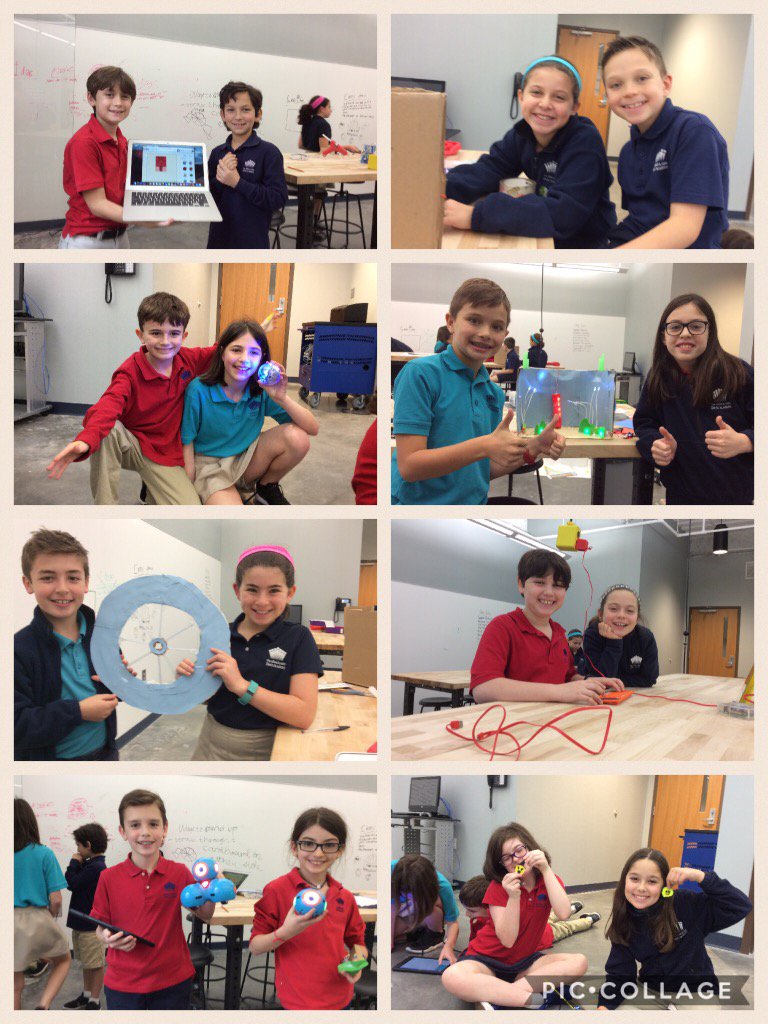
The fourth graders are enjoying being the inaugural regular class in there while the other grades are enjoying the flexibility to explore the space when time permits. We have had 2nd graders create 3D simple machines with Tinkercad in correlation with their simple machines unit. A shark-tank style panel will be voting on the most useful, well designed simple machine. The winning machines will be 3D printed for classroom use. Third graders made interesting inventions with LittleBits and worked in some time with the green screen in the audio visual production studio next door. Fifth graders have been creating their own video games with Bloxels, which has been all the rage. Discovering that they could animate their own game characters has been pretty extraordinary. 

What's to come? Well, the PTO will be creating Star Wars-themed circuits the week after next with the help of our 5th, 6th, and 7th grade Network Sherpas. A few of our fourth graders will be learning to sew in order to create new Mo Willems themed pillows for our media center. The 6th graders will also spend time with Bloxels in the Innovation and Design Studio to create their own digital worlds. In fact, we are looking forward to a Skype session with the makers of Bloxels to take our video games to the next level. The possibilities are somewhat limitless.

While we know that the learning that takes place is not about the space in which it occurs, it can certainly help to have a new amazing source of inspiration being surrounded by a space that begs for creativity. The greatest gift is being able to connect, create, and color our world a little brighter in a space that demands it. We look forward to sharing our creativity with the rest of the world. 

Wednesday, January 11, 2017

The Power of Video

Everyone loves a good flick. Using short clips in the classroom to frame a lesson, prove a point, or just to mix things up a bit can be very powerful. I have a couple of video clips that I love to use. The first is an oldie now but certainly a goodie. The YouTube clip of the child going down the steep ski slope for the first time is such a powerful way to demonstrate the value of bravery, the importance of positive self-talk, and the feeling of elation after accomplishing something big. I show this clip on the very first day of my entrepreneurial class because I am asking the students to step outside of their comfort zones and be brave. 

I also love to share all things Kid President. Every single one of his messages resonates with a philosophy that I am sharing in the classroom. Here's one about changing the world, which fits nicely with sharing bold ideas, taking risk, and again, being brave. It's a perfect match for budding entrepreneurs. His messages are positive, creative, and simply lovely. My class always asks for more of Kid President. 

Inspiring students to create their own videos worthy of the classroom is worthwhile too. You never know who will produce the "next big thing". It can start with us.


Monday, December 12, 2016

Silence December Doldrums

Gotta love a great John Green line.:
December represents a month of hectic craze, which is one of the reasons we all love it so much. It's the month that you fit in your regular priorities, mixed in with extra special time with friends, family, co-workers, perhaps make a little more time to give back to your community and maybe even take a vacation. It's a lot. In all the hubbub, it is easy to become frazzled. Assuming that "people are coming from a place of good" becomes key in the month of December. Throughout the overscheduling and the rushing around, shortcuts may be taken in how we handle each other with care. Assuming that people are coming from a place of good is a mantra that I've chosen to come back to often in work and in my personal life. 

I've come to understand that believing in the good of those around me creates resilience in my daily interactions. While always a work in progress, I work hard to consider this mantra when situations may not seem as ideal as I would like. Sometimes I need a little help remembering this mantra from my support system and in turn, sometimes I help others come back to this mantra. The more deliberate we are in our actions, the more thoughtful we are in our responses. Assuming that people are coming from a place of good, works every time, if you remember to think about it. Sometimes it is easier to remember than at other times but if you remember it can be so freeing. Next time a student, a teacher, a friend, a family member does something that challenges you to think of their actions in a positive light remember to assume first that their intention is a good one. It is a strategy that certainly helps regain focus during what is not only a trying month but it is also helpful all year round. As we train our minds to see the good in everything, we can be hopeful about a rich year ahead.

Monday, November 7, 2016

Gratitude and Giving Thanks

November is a great month for reflecting on where we feel gratitude not only because Thanksgiving is approaching but also, because it is on the eve of a new year. Being able to look back, think about where we have been and where we want to go is so valuable. In my opinion, feeling gratitude is all about perspective.

As an educator, I have much to be thankful for in my school community. I'll start with my team. I work with three fabulous ladies and together, we manage to come up with some amazingly outlandish ideas and see them through to execution. Together, we work hard to support each other, laugh at (I mean with) each other, challenge each other, and learn from each other. I am so grateful for my rock star team. Similarly, I feel the same for the administrators. They work seven days a week to provide support across all levels. They inspire creativity, help spark innovation, and trust their larger faculty. I also love their willingness to engage in a good, healthy debate when opinions don't always align. It's awesome. These are two groups that have definitely helped me grow this year. I'm learning to be more compassionate through their examples and to say no when I just really need to say no. I'm a work in progress but I'm also learning to keep an open mind. It's not always easy to steer away from judgment based on preconceived notions but I'm working on it. My own children's teachers have also helped me grow this year. Their reassurance, compassion, and humor makes me feel a sigh of relief when challenged with tough parenting moments. Through all of these examples, I am grateful for being reminded that I could be more of these things. The goal is not to strive for perfection but to be able to learn from our imperfections. 

Each year comes with its own challenges. As indicated above, I would say there have been several instances of over committing this year. I'm still learning the importance of saying no. I have also been challenged with expanding my view and trying to understand a different perspective when it comes to having different opinions. Interestingly, I used to pride myself on this trait but over the years, I have become more quick to formulate unfair assessments. I am working on this too. I suppose I am learning that it is rewarding to reflect often on the ways in which I can improve. Accepting that we are in a constant state of evolution is valuable. 

Stepping back and trying to see things through a variety of lenses as mentioned above can inspire us to say thank you more often. I am reminded of Todd Parr's book, It Is Okay To Be Different. Not only is it okay but it just is. We all view the world differently because we have such different experiences that make us who we are. Understanding this as we go through our day surely will help us appreciate others more and in kind, say thank you.